
The grey dots
March 2026
I've been an engineer for over 10 years now, and there is a material change happening in how we deliver things. I've always firmly sat in the “product engineer” camp. I see writing code as a means to an end, a tool for delivering value. These days I make extensive use of Claude Code to deliver things - I don't think I've actually written code by hand in weeks - but my views on how I feel I get the most from it and how I use it are probably for a separate post.
A few weeks ago I started seeing a visualisation of AI adoption being shared across social media. It showed 2,500 dots representing the world's population, illustrating how even though it feels like AI is everywhere, users are still very much in the minority. Most of the dots were grey.
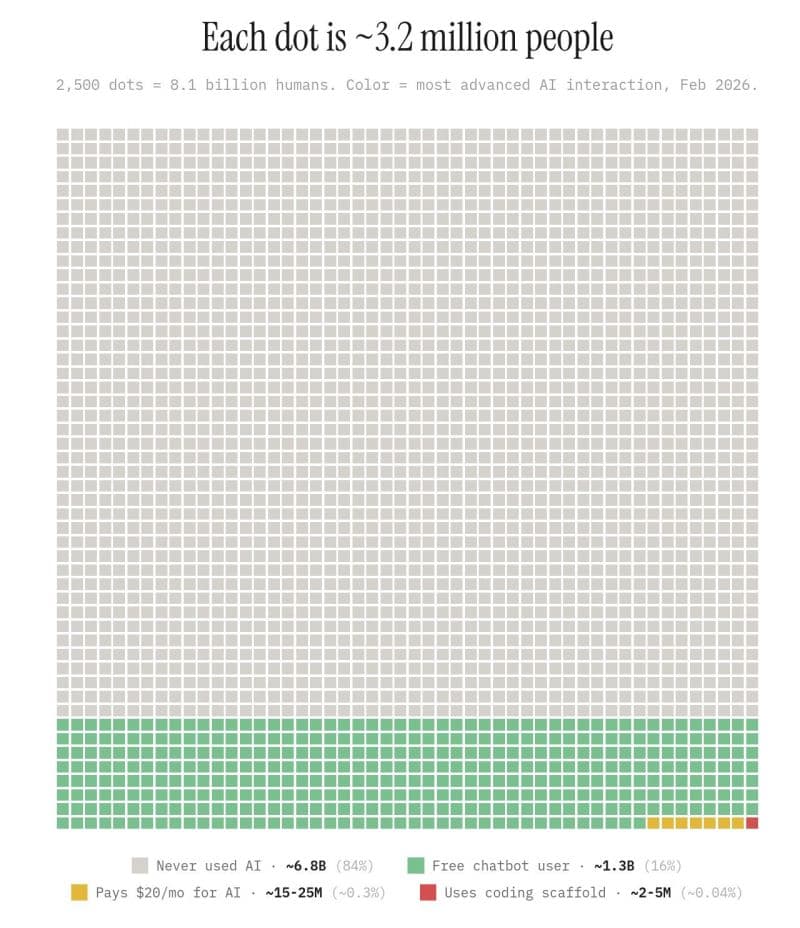
I started thinking about why so many of them were grey in the first place. Are they not interested? Have they just not got around to it yet? With the help of Claude, I tried to expand on the original data to find out. How many of them lack access to clean water? How many can't read? How many don't have electricity?
A few of the comparisons that didn't really land until I did this - particularly around those of us using AI to write code:
- For every one of us using AI coding tools, roughly 740 people are completely offline
- For every one of us using AI coding tools, roughly 1,100 people live below the World Bank poverty line ($8.30 a day)
- For every one of us using AI coding tools, roughly 630 people lack safely managed drinking water
- For every one of us using AI coding tools, roughly 210 people are illiterate
For a lot of those people, it's not that they're not interested. It's that they can't.
This started out as curiosity more than anything. But once I got into the detail and could actually see it laid out, it felt like holding up quite an uncomfortable mirror. I find it easy to forget all of this when I'm deep in the day to day of optimising prompts and spinning up multiple agents to “10x my output”. When you're inside that bubble it genuinely feels like the whole world is moving together. It isn't.
The irony of this post, given that I used Claude to build both the visualisation and this site, is not lost on me. I don't really have a neat conclusion for any of this. I just think it's worth reflecting on how small the world we're operating in still is.
You can also view the standalone visualisation on its own.
Each dot is ~3.2 million people
2,500 dots = 8.1 billion humans. Color = most advanced AI interaction, Feb 2026.
- 84% of humanity has never interacted with AI.
- Those who pay for it — 15 to 25 million people — are less than 0.3% of the world’s population.
- Engineers using AI coding tools number just 2 to 5 million.